

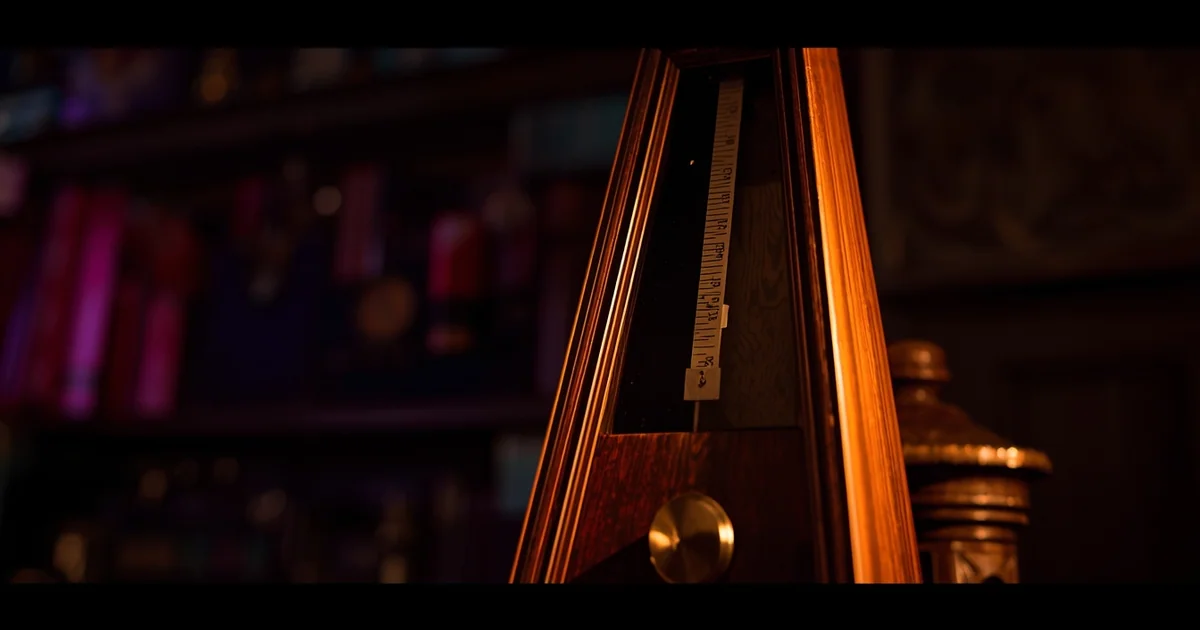
Why the Metronome Is Your Most Important Practice Tool
Ask any professional musician what separates good players from great ones, and timing will be near the top of every list. You can know every scale, every chord voicing, every technique — but if your timing is loose, nothing else matters. An audience will forgive a wrong note. They won't forgive a wrong beat.
The metronome is the simplest, most effective tool for building solid time. It doesn't lie, it doesn't slow down when you struggle, and it doesn't speed up when you're excited. It's the objective truth about where the beat is — and your job is to match it.
Getting Started: The Basics
Setting the Right Tempo
Start slower than you think you need to. If you're practicing a passage and you can play it at 120 BPM, set the metronome to 100. The goal isn't to play fast — it's to play perfectly in time at whatever tempo you set. Speed comes from accuracy, not the other way around.
A good metronome offers a wide BPM range. VampJam's free online metronome covers 40 to 240 BPM — slow enough for ballad practice, fast enough for thrash metal. No signup required to use it.
Counting Along
Before you play a note, count along with the metronome. Out loud. "One, two, three, four. One, two, three, four." This might feel silly, but it internalizes the beat in a way that just listening never will.
Once counting feels natural, add your instrument. If you lose the beat, stop playing and go back to counting. The metronome is always right — if you're not lining up with it, adjust yourself, not the metronome.
Understanding the Click
Each click represents one beat. In 4/4 time (the most common time signature), you get four clicks per bar. The downbeat — beat 1 — is typically accented (a higher-pitched click) so you can hear where each bar starts.
VampJam's metronome uses a distinct pitch difference between the downbeat (1000 Hz) and regular beats (800 Hz), with a visual indicator that highlights each beat as it passes. The visual cue is especially helpful for practicing silently or in noisy environments.
Essential Metronome Exercises
Exercise 1: Quarter Notes
The most basic exercise — and the most revealing. Play one note per click. Any note, any technique. Just land exactly on the click.
This sounds trivial. Try it at 60 BPM for two minutes straight without rushing or dragging. Most players can't do it on the first attempt. The slow tempo exposes every micro-timing error that faster tempos mask.
Exercise 2: Eighth Notes
Play two evenly spaced notes per click. The click lands on the downbeat, and your second note should fall exactly halfway between clicks. No swing, no shuffle — perfectly even.
This is where most intermediate players discover their timing isn't as solid as they thought. The space between clicks is where sloppy rhythm hides.
Exercise 3: The Silence Test
Set the metronome to a slow tempo (60-70 BPM). Play for four bars, then stop playing for four bars while the metronome continues. Start playing again at bar 9. Did you come in on beat 1? If not, your internal clock drifted during the silence.
Increase the silence to 8 bars, then 16. This exercise builds an internal sense of time that doesn't depend on hearing the click.
Exercise 4: Beats 2 and 4
This is the exercise that separates hobbyists from serious players. Set the metronome to a moderate tempo and feel the click as beats 2 and 4 instead of 1 and 3. In other words, the first click you hear is beat 2, not beat 1.
This is how rhythm sections feel the beat in jazz, funk, R&B, and most popular music. The backbeat (2 and 4) is where the snare drum lives, and feeling it there changes your entire approach to groove. It's uncomfortable at first. Stick with it — this exercise fundamentally rewires your rhythmic feel.
Exercise 5: Subdivisions
Set the metronome to a moderate tempo and practice cycling through subdivisions without changing the tempo:
- Quarter notes (1 note per beat)
- Eighth notes (2 per beat)
- Triplets (3 per beat)
- Sixteenth notes (4 per beat)
The transitions between subdivisions are where most mistakes happen. Can you switch from eighth notes to triplets mid-phrase without losing the tempo? This is essential for genres like blues and jazz where triplet and straight feels coexist.
VampJam's metronome supports beat division options — half-time, normal, and double-time — so you can hear the subdivisions you're targeting.
Common Metronome Mistakes
Mistake 1: Always Practicing With the Metronome
This sounds counterintuitive, but hear it out. The metronome is a diagnostic tool, not a permanent accompaniment. Practice WITH it to identify timing problems. Practice WITHOUT it to develop your own internal clock. Alternate between both.
Mistake 2: Playing Too Fast Too Soon
If you can't play something perfectly at 80 BPM, you can't play it at 160 BPM — you're just playing it wrong faster. Always start below your comfort zone and build up gradually.
Mistake 3: Ignoring the Space Between Notes
Most timing errors don't happen on the note — they happen in the silence between notes. Focus on when you release notes and when you prepare for the next note, not just when you attack.
Mistake 4: Only Practicing in 4/4
If you only ever practice in 4/4 time, your rhythmic vocabulary is limited. Try counting in 3/4 (waltz), 6/8 (compound time), or 5/4 (odd meter) to develop rhythmic flexibility.
Metronome + Backing Tracks: The Best Combination
A metronome alone builds time. A backing track alone provides musical context. Together, they're the ideal practice environment.
Here's the approach: use the metronome during warm-ups and technique blocks to ensure your time is tight. Then switch to a backing track for musical application. The backing track provides groove and harmony — things a metronome can't offer — while your metronome-trained timing keeps you locked in.
On VampJam, both tools are integrated into the same player. You can generate a custom backing track and have the metronome running alongside it, or switch between them depending on the practice block. Add loop markers to isolate sections, and the tempo trainer to gradually build speed — all in one interface.
How to Know When Your Timing Is Improving
Progress with timing is subtle. You won't suddenly "get it" one day — you'll gradually notice improvements:
- You can play the silence test for 16 bars without drifting
- You can feel beats 2 and 4 as the default, not just when you think about it
- You can switch between subdivisions without hesitating
- Playing with other musicians feels easier — you're not chasing their tempo
- Your recordings sound tighter than they did a month ago
The metronome makes these improvements measurable. If you couldn't play a passage cleanly at 130 BPM last week but can this week, that's quantifiable progress. Track your ceiling tempos for specific exercises and watch them climb over weeks and months.
Beyond the Click
The ultimate goal isn't to be a human metronome — it's to have such a solid internal clock that you can play ahead of, behind, or right on top of the beat intentionally. Laying back behind the beat in a blues feels different from pushing ahead in a punk song, and both feel different from sitting right on top of the beat in a funk groove.
You can't play intentionally ahead or behind the beat if you don't know where the beat is. The metronome teaches you where it is. What you do with that knowledge is musicianship.
Ready to build better timing? Try our free online metronome right now — no signup needed. Or create a free VampJam account for the full practice suite including custom backing tracks, tempo trainer, loop markers, and practice timer.